Factual review: 6 October 2026.
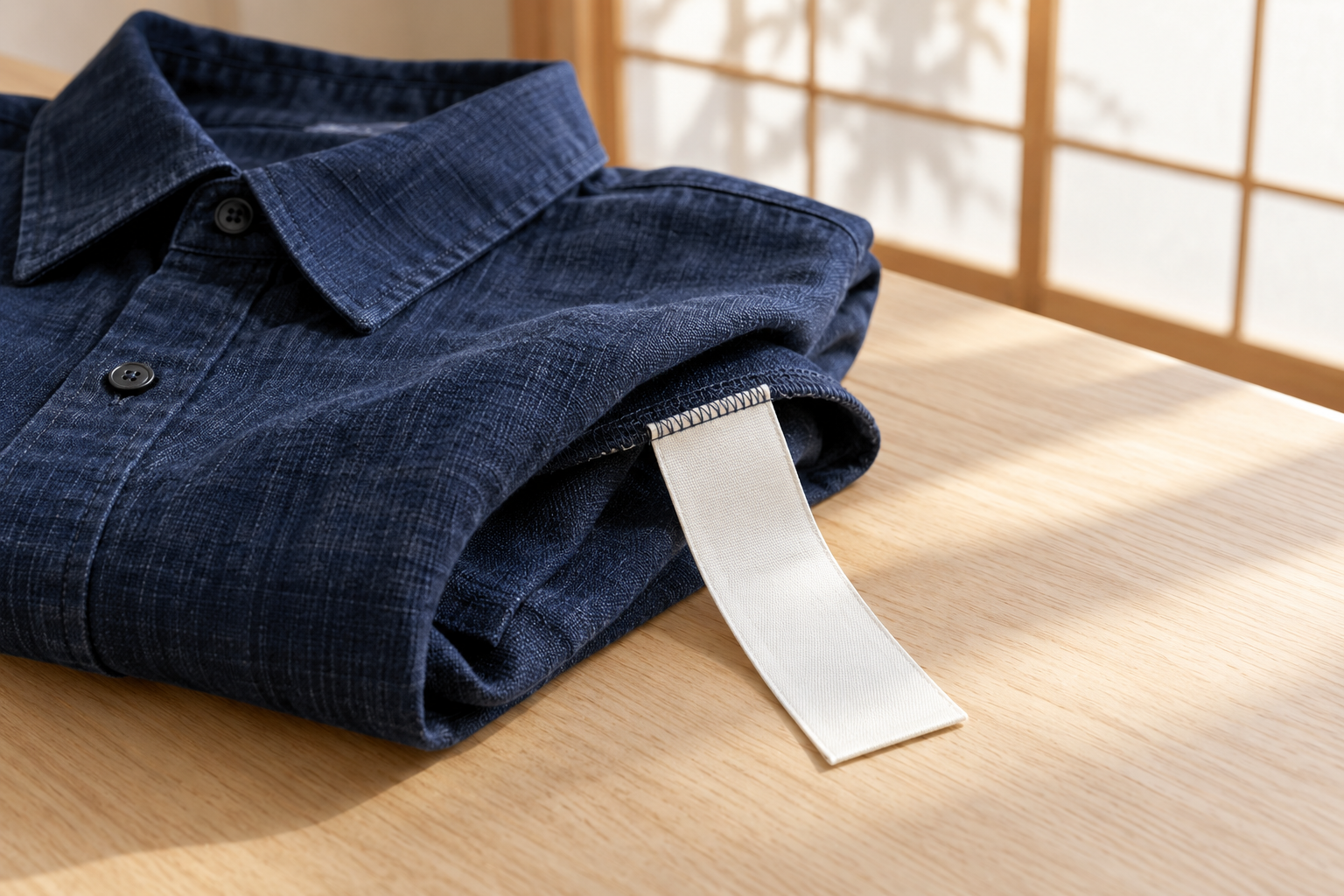
AI-generated editorial illustration; not a production-approved label or placement diagram.
Preparing clothing for Japan starts with three questions: what is it made of, how should it be cared for, and which business is responsible for the label? For a conventional shirt, these correspond to the main quality-labelling information described by Japan’s Consumer Affairs Agency (CAA). CAA shirt guide, sections 1–3.
The practical task is to confirm that information before approving artwork. Translating an existing label is only part of the work.
This introduction focuses on ordinary adult textile clothing sold to consumers in Japan. It explains quality labelling; product safety, customs and specialist garments need separate checks.
Which rules apply in Japan?
The framework has three connected parts:
| Reference | What it does |
|---|---|
| Household Goods Quality Labeling Act | Establishes the framework for quality information on designated consumer goods. |
| Textile Goods Quality Labeling Regulation | Specifies the textile products, information and labelling methods covered. |
| JIS L 0001:2024 | Provides the care-symbol system referenced by the textile regulation. JIS stands for Japanese Industrial Standards. |
These have different roles. The Act and regulation establish the legal framework; the technical standard supplies the referenced symbol system. Act, Articles 2–3; textile regulation, Articles 1–3.
Start with the product category. The regulation’s Table 1 assigns different information to different items, so do not assume that every textile product needs the same label.
Prepare the three main information areas
Fibre composition
For the shirt example, declare the relevant fibres using the prescribed names and percentages. Check the garment’s construction before deciding which components the declaration needs to cover. Textile regulation, Articles 2, 3 and 6, and Table 2.
Use Japan’s prescribed terminology rather than an unchecked translation of the supplier’s description. For cotton, the permitted terms include 綿, コットン and COTTON. It would therefore be inaccurate to say that every fibre name must appear only in Japanese. CAA fibre terminology table, cotton entry.
For a first range, ask your Japanese partner to review the composition wording alongside the product specification. Leave special blends, linings and unusual materials for a more detailed check.
The business responsible for the label
The labeller is the business responsible for the quality information. The label needs its name plus an address or telephone number. For imported goods, CAA guidance identifies a Japanese business—an importer, seller or labelling contractor—as the labeller. CAA shirt guide, section 3; CAA handbook, textile section, page 7.
Agree the responsible party and exact details before printing. CAA guidance says an address should be presented in Japanese; an email address, website or QR code cannot replace the required address or telephone number. CAA general FAQs, Q3 and Q5.
Care information
Choose care instructions from evidence about the product. The regulation permits specified or equivalent test results, as well as predictable results based on accumulated technical information and similar evidence. Independent laboratory testing is not stated as the only route. Textile regulation, Article 3(2).
Review the finished garment, including its trims, print and finish. Knowing that a shirt contains cotton does not, by itself, establish the appropriate washing or drying treatment.
Understand the JIS care symbols
For products requiring care information, the current regulation references JIS L 0001:2024. The system covers five groups: washing, bleaching, drying, ironing and professional cleaning. Drying includes tumble and natural drying; professional cleaning includes dry cleaning and wet cleaning. These groups do not mean that every garment has exactly five printed marks. CAA textile FAQs, Q1–4.
JIS L 0001:2024 is based on ISO 3758:2023 with technical modifications. Familiar-looking symbols are a useful starting point, but they do not establish that an EU or other overseas label can be reused unchanged. JSA standard preview, Introduction.
The care amendment took effect on 20 August 2024. Its transition allowed the previous rules to be used for labelling carried out through 19 August 2025. For new label preparation, check legacy artwork against the current requirements. That transition should not be read as a universal deadline for selling previously labelled stock. Textile regulation, supplementary provisions to Notice 9.
Make the label readable and durable
CAA guidance distinguishes composition information from care information. Composition may appear on a hang tag where it is visible from outside; care information generally needs attachment that does not easily come away from the garment. Sewing is one option, with other durable methods also recognised. CAA textile FAQs, Q6 and Q12–14.
Care information should withstand the relevant cleaning processes and remain readable during the product’s useful life. Narrow exceptions exist for certain delicate accessories and hats, so check the category before using a removable care tag. If composition and care appear on separate quality labels, each needs the labeller details. CAA textile FAQs, Q6 and Q12–14.
A simple shirt example
Imagine a conventional woven shirt with verified 100% cotton composition and no construction requiring additional component declarations. Its information could be organised as follows:
| Information block | What the team prepares |
|---|---|
| Composition | 綿 100%, meaning “100% cotton”. |
| Care | Applicable JIS symbols selected from evidence for the finished shirt. |
| Labeller | The agreed responsible business name and address or telephone number. |
This illustrates the information blocks, not a complete printable label. The care instructions need their own supporting evidence, and the Japanese partner should confirm the actual business details. Check the finished arrangement against the CAA shirt guidance and attachment rules above.
Before approving production
Use this practical review sequence with your supplier and Japanese partner:
- Classify the garment and confirm its required information.
- Verify composition and the prescribed wording.
- Confirm the labeller and exact contact details.
- Support the care decision and check the applicable JIS artwork.
- Inspect a physical sample for readability, attachment and durability.
- Approve one final version and give it to the factory with the agreed specification.
Keep separate checks for product safety, import requirements and origin claims on the launch plan. A clear quality label is one part of preparing a garment for sale in Japan.
Related guides
- EU clothing labelling requirements
- US clothing labelling requirements
- South Korea clothing labels and Korean wash symbols
Topics: Care Symbols